FREE JAZZ NOTES
Want a free book? Head on over to the review of Jazz Notes at HJ and post a comment. Then, free book will be yours. Only available for the first 4 comments!
Want a free book? Head on over to the review of Jazz Notes at HJ and post a comment. Then, free book will be yours. Only available for the first 4 comments!

Dan Merchant wonders, “Guys, guys [and presumably gals, too]—how are we supposed to have a conversation when everybody’s talking at once? Why is the Gospel of love dividing America?” Want to know why? Merchant decided to find out, so he donned a religious bumper-sticker-covered jumpsuit and set out across America in the documentary Lord, Save Us From Your Followers.
Along the way, Merchant meets Southern Baptists, apathetic Protestants, atheists, Al Franken, Catholics, homosexuals, Jim Santorum, a cross-dressing nun, and Tony Campolo calling Jon Stewart a “prophet of God” (referencing Tucker Carlson’s Crossfire on CNN, October 2004). He listens, asks, talks, pokes, prods. People critique his bumper stickers. They talk religion. In a conversation.
Merchant meets Ron Luce, leader of the national youth movement “Battle Cry” and discusses the “bee-hive” Luce and the event ran into in San Francisco. “Battle Cry” wants today’s Christian youth to speak out against the mass media culture that has turned America, a “Christian nation” according to Luce, into a culture opposed to Christianity. In San Francisco, “Battle Cry” staged a protest event on the steps of the San Francisco City Hall.
“It’s like we put our finger into a bee hive, and we didn’t know it—we didn’t realize it was a hotbed for a very violent response to people who represent the Bible,” Luce said.
This situation, according to Joe Garofoli, of the San Francisco Chronicle, put this Christian event on the same sacred steps for gay marriage, where the Mayor had decided to bless gay marriages just a few years ago. After the blow-up during the first event and plentiful press coverage, Luce brought “Battle Cry” back to San Francisco the next year, and again held a protest on the front steps of City Hall.
Merchant’s documentary opens with an animation of commentary from talking heads:
Jon Stewart: “Religion: it’s a powerful healing force in a world torn apart by… religion.”
Jerry Falwell: “We formed the Moral Majority. We weren’t intending to say everyone else is in the Immoral Minority.”
Merchant hit the streets and asked for the opinion of Americans on what Christians are all about: to be holy. Fanaticism. The Crusades. Killing off non-Christians. Trying to get other people to be Christians. Being good people That “love thy neighbor” thing. Theatrics. Jesus Christ. Being really snobby. Hypocritical. “Preparing to be holy, and being butt-[censored] wild behind closed doors. And that’s a fact.”
For Merchant, the trip began on a trip to Ethiopia, where he met Christians “full of joy, kindness and grace, despite living with daily hardships that would snap [him] in half.” That messed him up, he said, because he started to recognize the “stark contrast” between the Christians in Ethiopia, and the Christians he saw in America. “This collision of faith and culture in America—is killing me,” Merchant says. “It’s one thing to project our faith from a bumper sticker, it’s another to have a conversation. I think we’re getting it wrong again.”
Some will recognize this title from the book release. Lord Save Us has garnered attention from the Today Show and a USA Today Op/Ed piece. The film is available on DVD via group-screening license, by free download from the film’s website, or in a planned limited theatrical release June 13.
As documentaries go, Merchant and co-producer Jeff Martin produced a solid one. Both put their extensive television and film production experience to work, and through their production label hope to create more titles that express the spiritual truths of grace, redemption, and forgiveness.
The voices they include in Lord Save Us span the colors and faces of America and give a multi-sided voice to this commentary on Christianity in America. Politics and hot topics make up the early minutes of the film, while social justice and humility fill the later minutes. The film is also up-to-date, including footage of the Iowa Debates between Hillary Clinton and Barack Obama.
Through much of the film, there is a visual stimulation overload with animation, news clips, original interviews, talking heads, images, and music. Yet the representation implied is clear: there are many, many voices… and as Merchant noted early in the film, they’re all talking at once, and few are listening.
 In college, one of my friends thought a jazz book was misplaced in the spirituality section of the local bookstore. He bought it, liked it, passed it around his apartment and the rest of campus. None of us realized how big this book would be. That was Blue Like Jazz in 2003, which author Donald Miller himself never imagined would be a big hit. Miller admits in Jazz Notes that the books success surprised him, and he “anticipated about 90 percent more [negative feedback]” than he got.
Five years later, Miller himself has moved on, as have many of the crowd’s favorite characters, including Tony the Beat Poet and Pastor Rick. The book had sold over one million copies, and the screenplay for “Blue Like Jazz: The Movie” is complete and ready for filming. Now, Miller revisits Blue Like Jazz with Jazz Notes: Improvisations on Blue Like Jazz, a remix version, giftbook style.
Miller’s story is riveting at times. His stories are vividly honest and he asks questions that other people of faith often avoid. He talks about the first time he sinned at the age of 10. He talks about his friend Laura, a pastor’s daughter and avid non-Christian, exploring God and the Bible. He tells the ever-popular story of setting up a Confession Booth at Reed College in Portland, a notoriously secular school, where he and his friends apologized for everything that Christians had done wrong.
Blue Like Jazz is one of those books that I read nearly a half-dozen times, and it was difficult to decipher the new material from the old in Jazz Notes. Even if you have read it a dozen times, Miller writes with a freshness that will grab you every time. Clips from Blue Like Jazz are woven together with Miller’s commentary, new stories, and updates on the original story. The book also features a CD of Miller reading excerpts from the audio book.
If you are really interested in Blue Like Jazz, I would recommend the entire book. If you’ve read Blue Like Jazz and know friends who would like it, or if you want just a quick read, pick up a copy of Jazz Notes. And stay tuned for “Blue Like Jazz: The Movie” and Let Story Guide You, Miller’s much anticipated new book due out later this year.
 The American frontier was often a dark and scary place for those back home. If you weren’t adventurous enough to head out west on your own, you sat back home and worried about those who did. Tony Jones tells a story of a mother and father grief-stricken at the unknown: their daughter and her new husband had ventured to the new frontier, and for months they had no word from their daughter. They did of the frontier’s horrors in the newspaper: disease, extreme weather conditions, poor health and fights with the Indians.
In The New Christians, Jones introduces the world to the new frontier of emerging Christianity. Emerging church leaders, Jones says, are moving their churches to focus more on outward, Gospel-inspired ideas than on self-preservation.
Jones and others have received much flak from prominent Protestant leaders. He jokes that any church leader reading The New Christians would receive less criticism by covering the book with a dirty magazine than to show what they are reading. A pastor joining Jones on a convention panel, warned the audience, “It’s dangerous...if these Emergent guys get their way, pretty soon we’ll be [practicing bestiality].” Jones strongly denies this claim, but acknowledges the source of these fears. “The primary concern for traditional evangelicals,” Jones says, “is the specter of relativism.”
For centuries, people have taken their faith quite seriously, and Jones is unabashedly turning his boat in a different direction. He writes of someone who likened the traditional church to an ocean liner. One day, a small group boarded a life raft and set off in a new direction, only to find that “scores of others” wanted to follow. This “life raft” is taking faith more seriously, calling people to a deeper understanding of their belief and calling into question any “easy answer.”
For many of his opponents, particularly evangelical megachurch pastors, the message of the Christian faith has been simplified in order to draw a Gen X crowd back into the church. That worked, Jones said, for that generation, but others want something deeper.
Emergent is not the faith of a church claiming to set itself apart from culture while promoting Hollywood blockbusters (think Evan Almighty or Passion of the Christ), selling their books to discount retailers (Joel Osteen, Rick Warren) or “reveling in their newfound influence...on Capitol Hill,” Jones writes. This is a faith that finds spirituality in all of culture, finding hope in the redemptive, humanizing side of Ryan Seacrest in American Idol, balancing out the chastising voices of Randy, Paula and Simon.
The PR company’s press release said that Jones visited four emergent churches across the country, so I expected a case study of sorts. What Jones delivers is a story: of the early days, before anyone called this “Emergent”; of the detractors and his response to their position; and the stories of these four churches.
In the early days of the American frontier, dispatches were the source of what people in the East learned about the Wild West. Here’s what Jones says, in the dispatched from The New Christians, the Emerging Church is all about:
Dispatch 1
Emergents find little importance in the differences between the various flavors of Christianity. Instead, they practice a generous orthodoxy that appreciates the contributions of all Christian movements.Dispatch 6
Emergents see God’s activity in all aspects of culture and reject the sacred-secular divide.Dispatch 12
Emergents embrace the whole bible, the glory and the pathos.Dispatch 19
Emergents downplay -- or outright reject -- the difference between clergy and laity.
Emergent Churches don’t necessarily resemble typical Christianity in their gatherings, although some aspects are familiar. Tim Keel, pastor at Jacob’s Well in Kansas City, invites audience participation in his sermon. Journey in Dallas has a podium in the center of the room, surrounded by chairs with a stage on one side, and the band begins with worship music from evangelical recording artists. Karen Ward, pastor-priest of Church of the Apostles in Seattle, VJs the worship service while others take on leadership. At Solomon’s Porch in Minneapolis, members gather during the week to craft the following week’s sermon.
Emergent Churches may not speak to everyone (although Jones’ fear of his parents disapproval of his church was unfounded: “My parents loved it!!”), but it has drawn in many disenfranchised with traditional forms of church. The New Christians is deeply theological (words about God). It is not a light read or a quick one and will give you a lot to chew on. And you may not agree with everything Jones writes.
In Glenn Beck’s column last week on CNN.com, he told of a theology course he took a few years ago where the professor assigned only the books with which he agreed. Beck asked the professor for a list of books he disagreed with and read those as well. Whether or not you think you might agree with Jones and Emergent, allow yourself the space to read The New Christians and make your own opinion. You might decide to jump off on the life raft.
Check it out: my preview of The New Christians, Tony Jones' latest due in stores next week.
I wrote the preview (duh!) before I read the book, but now that I've started, it's hard to put it down! It certainly gives me hope for the church. Stay tuned, the full-fledged review will be up in a few days, and I'll post it here too.
 My friend’s dad passed away Monday night. He lived a great life of fifty-six years, and died having spent special time with his family by his side. In death, life seems more precious. More precious for me. More precious as we reflect on his life lived. Precious life.
Milt Shields has passed his ninety-seventh birthday with barely a hiccup. His physical health is impeccable; he played tennis and golf until his mid-nineties, and still swims a few laps a day in the neighborhood pool. He says he has seen a doctor more from 94 to 97 than he did in his first 94 years, yet only a colonoscopy has kept him back in recent days. His son, David, however, is not so healthy: he boasts an aching back, a receding hairline, a reconstructed leg and, most importantly, a birthday past fifty. He views his own physical problems as an indicator of his aging as he reflects on birth, life and death in his memoir The Thing About Life Is That One Day You’ll Be Dead.
Shields follows the four stages of life: infancy and childhood; adolescence; adulthood; and old age and death. In each stage, he weaves the biology of that life-stages, stories from literature and history, the well-matured life experience of his father and the days of his own fifty-one years.
In the first half of the book, Shields writes as though the glass is half-full. These young years bring life, hope and vitality, and Shields writes with a sense of longing for those years. In his own adolescence, his star athletic abilities were snatched from his life by an untimely injury. Hope is gone. When he begins writing on adulthood, the glass becomes half-empty. Life is no longer a wonderful gift, rather a curse that ends in death.
Shields views the purpose of life as reproduction. After children are born, life is lived on a downhill slope, speeding rapidly toward impending death. Shields writes as an atheist (raised in the Jewish faith), so his perspective (fear) of death can be understood in that light.
The biological implications of aging, along with Shields’ apprehension at moving toward death, yield the dark side to his writing. The scientific exploration follows his writing in verifying the decline of the human body after adolescence and early adulthood. Yet the evidence provides a fascinating glimpse into the complexity of human life and the changes we have seen in humanity from generation to generation. Did you know:
“You’re born with 350 bones (long, short, flat, and irregular); as you grow, the bones fuse together: an adult’s body has 206 bones.”
“Cardiovascular disease kills 40 to 50 percent of people in developed countries. Cancer kills 30 to 40 percent; car accidents kill 2 percent; other kinds of accidents kill another 2 percent.”
“A major new study of body weight and health risks by the Centers for Disease Control and Prevention and the National Cancer Institute concluded that the very thing (a person with a body mass index below 18.5 -- for instance, a man who is 6’ and weighs 136 pounds or a woman who is 5’6” and weighs 114) run the same risk of early death as the very fat.”
“Your IQ is highest between ages 18 and 25. Once your brain peaks in size -- at age 25 -- it starts shrinking, losing weight, and filling with fluid.”
From generation to generation, life changes and is increasingly complex. “In 1900, 75 percent of people in the United States died before they reached age 65; now, 70 percent of people die after age 65.” Medicine, diet and technology in the last century have lengthened our lives. Yet the proverbial “fountain of youth” has not yet been found.
Shields’ stories will draw you in. One biology fact will make you want to change your life habits one way. The next will push you the other. The wit and humor from lives gone by will make you laugh and think, and long for a vibrant life.
The thing about life is that one day you will be dead. How will you live yours?
Disclaimer: This book’s MPAA rating would be PG13. Shields is deeply honest and open -- not dirty, just brutally honest -- regarding human biology and sexuality.
 When our lives are rhythmically in tune with God, the music of our lives is played out to anyone around us who cares to listen. Maxwell “Wizard” Wallace (Robin Williams) says to young August Rush (Freddie Highmore), “[Music] is God’s reminder that there’s something bigger than all of us.”
August Rush grew up in a boys home, known as Evan Taylor. Separated from his mother, Lyla Novacek (Keri Russell), at birth by her over-protective father, both desperately wanted to know the other existed. Living a life of feigned existence and separation, neither pursued their shared passion for music. But an innate sense brought them back to music.
Evan begins the movie in a field, swaying in rhythm with the music of the wind saying, “I believe in music, the way that some people believe in fairy tales. What I hear came from my mother and father, once upon a time.” The movie also follows his father, Louis Connelly (Jonathan Rhys Meyers), working as a West Coast businessman, also avoiding his former life as lead singer of a band.
After Richard Jeffries (Terrence Howard) from the Department of Child Services checks in with Evan and the boys at the home, Evan decides that now is the time to find his mother. He sets off for New York City with nothing but the music of his soul.
When Evan first meets “Wizard,” he picks up a guitar for the first time and instantly shows off his musical prowess. “Wizard” wants to give Evan a new name, August Rush, and give him a platform to share his music. Sounds a bit like the Saul-to-Paul transformation in the New Testament.
 After police raid “Wizard’s” hangout, August is left wandering the streets of New York. He hears music coming from a church and wanders in to find a gospel choir in the midst of their practice. He finds Hope (Jamia Simone Nash), a young girl in the choir, who gives him a place to sleep, teaches him about music and introduces August to the minister.
Up to this point, Evan’s music came from the heart. He didn’t have a process or a structure or rules. His music came out of a childlike innocence, innocent and pure. Sitting at a piano in the church, Hope asks him, “Do you know your notes?” August is caught off guard: “I’ve never seen them like that before.” A childlike faith can be caught off guard in the same way when introduced to rules and regulations of religion.
August’s musical prowess took the minister’s breath away, and the minister found a way for August to attend Julliard. Learning how to write music, he composes a full-scale rhapsody which his professor discovers. The professor passes the rhapsody onto the Dean (Marian Seldes). She called August into a board meeting, where they informed August that they wanted the New York Philharmonic to play his rhapsody:
August: How many people will hear it?
The Dean: It will be performed in Central Park, on the Great Lawn.
August: A hundred?
The Dean: Much more. Thousands.
August: OK, I need to play it to a lot of people. Lots and lots.
Even with this newfound knowledge about music, August has not lost his passion and excitement. He wants nothing more than to share the music of his life with as many people as he can. What if people of faith lived with that same eagerness to share their passion?
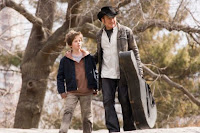 “Wizard” constantly reminds August of the importance of his music, its connection to his heart and the world around him: “You gotta love music more than you love food, more than your life and more than yourself...You know what music is? A harmonic connection between all human beings.” Our spirituality longs to be number one and that “music” in our lives will connect us to the world around us.
August asks “Wizard” where the music comes from: “I think it comes from all around you, really. It comes through us, some of us. It’s invisible, but you feel it.” August asks, “So only some of us can hear it?” and “Wizard” responds: “Only some of us are listening.”
Are you listening to the music this Christmas season? August found the music, lived the music and shared the music.
The music is all around us. All you have to do is listen.” - August